
How to calculate weighted FFB grading deductions
What FFB grading and quality deductions are
When an FFB truck arrives at a palm oil mill, the grader takes a sample of bunches and sorts it by quality criterion: unripe, underripe, ripe, overripe, rotten, empty bunches, long stalks, and trash or dirt (sand, stones, leaves). Fruit that does not meet the criteria is considered to lower the extraction rate, so part of the ticket weight is deducted. The result is the “normal” weight on which payment or costing is based.
Why the deduction is weighted
Each criterion has a different impact. One percent of rotten bunches is usually judged more damaging than one percent of overripe bunches. Each criterion is therefore given a weight: the percentage deducted for every 1% of bunches in that criterion. A weight of 50 means every 1% of unripe bunches deducts 0.5% of the weight; a weight of 100 means a full deduction.
The size of each weight is company policy or the outcome of an agreement between the mill and its suppliers. This article does not set a “correct” weight; what matters is that the weights are written down, agreed and applied consistently.
Formula
For bunch criteria, the percentage is based on the number of bunches (for example, 3 unripe bunches in a 100-bunch sample = 3%). For trash or dirt, the percentage is based on weight, not the number of bunches.
Worked example
The example below uses a 100-bunch sample and a ticket net weight of 10,000 kg. The weights are the Sawitara defaults, which can be changed per mill; these figures are an example, not an official standard.
| Criterion | Sample result | Weight (example) | Deduction |
|---|---|---|---|
| Unripe | 3 bunches = 3% | 50 | 3 × 50 ÷ 100 = 1.50% |
| Underripe | 8 bunches = 8% | 25 | 2.00% |
| Overripe | 4 bunches = 4% | 5 | 0.20% |
| Rotten | 1 bunch = 1% | 100 | 1.00% |
| Empty bunches | 0% | 100 | 0.00% |
| Long stalks | 10 bunches = 10% | 2 | 0.20% |
| Trash/dirt | 1.5% of sample weight | 100 | 1.50% |
| Total | 6.40% |
Deduction = 10,000 × 6.40 ÷ 100 = 640 kg. Normal weight = 10,000 − 640 = 9,360 kg.
Common mistakes
- Adding up percentages without weights. In the example above, adding 3 + 8 + 4 + 1 + 10 + 1.5 gives 27.5%, far from 6.40%.
- Counting trash per bunch. Trash and dirt do not come in bunches; calculate them by weight.
- Different formulas in different places. The grading screen uses one formula, the grading minutes use another in a spreadsheet, and the ticket rounds differently. The supplier sees three figures for one truck.
- No upper limit. A typo (80 instead of 8) can deduct most of the weight. A cap on the total deduction helps reject entries that make no sense.
- Weights changed without a record. Changing weights mid-period without a trail makes disputes hard to settle.
How Sawitara handles it
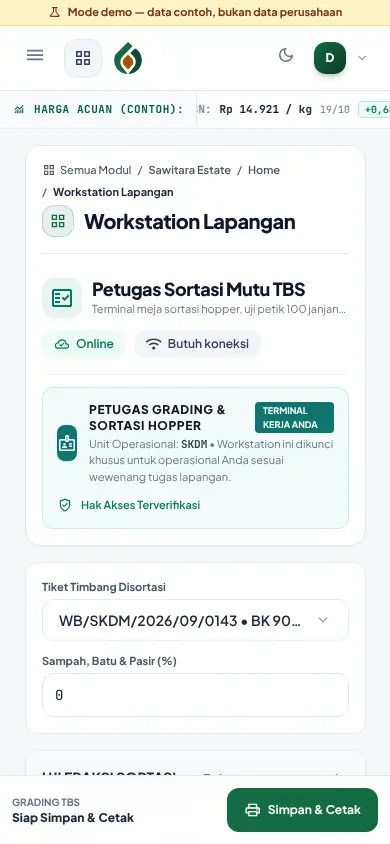
In Sawitara, the formula above is written once on the server and reused by the grading screen, the grader workstation on a phone, the grading minutes (berita acara sortasi) and the weighbridge ticket slip. Each criterion’s weight and the total deduction cap are set in Parameter Bisnis › Timbangan (Business Parameters › Weighbridge) and can differ per mill; parameter changes are logged. The deduction per criterion is rounded to four decimals and the total to two, so the figures on screen and on paper match.
See Sawitara with demo data
In 15 minutes we walk you from estate to general ledger, then discuss the products you need.